Service Dogs in Training in Georgia: Do They Have Public Access?
This page explains the law in general terms. It is not legal advice. For a specific situation, contact the agency listed on this site or an attorney.
If you are raising or training a service dog in Georgia, one question comes up fast: can the dog come into the grocery store, the bank or a restaurant while it is still learning? The answer depends on two different sets of law, and Georgia changed its rules in 2026.
This guide walks through how to find out where your dog in training can go, how to plan outings, and what to do when a business says no. It is not legal advice. For rights questions, rely on the agencies and statutes named below.
The short answer
The federal ADA does not give public access to a dog that is still in training. Georgia law has long had its own rules for trainers and puppy raisers, and the state rewrote its service dog law in 2026. The details of the new law matter, so treat the points below as a guide and read the official text before you rely on any one detail.
What you need before you start
- The name and contact details of the school or program that is training the dog, if there is one.
- Any written paperwork from that program, such as a letter confirming you are a trainer or puppy raiser.
- The dog's age and its housebreaking record, so you can say clearly where the dog stands.
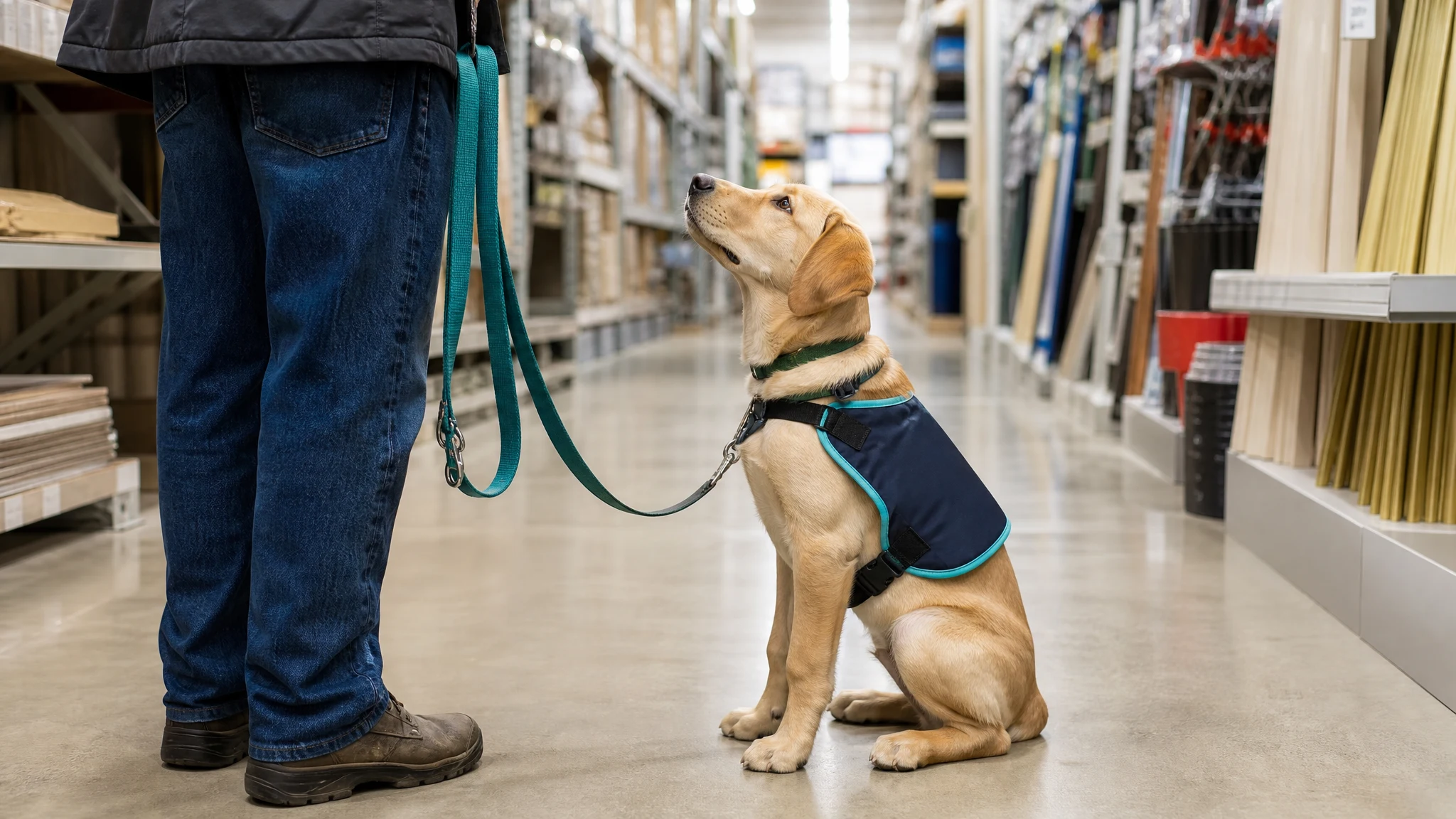
- A leash and a plain harness or vest that identifies the dog as a service dog in training, if your program uses one.
- A notebook or phone note for each outing, covering where you went, what the dog did well and what needs work.
- A copy of the current Georgia statute text, which you can print and keep with your records.
Step 1: Separate the federal rule from the state rule
Start with what the ADA says, because many people mix it up with state law.
According to ADA.gov, a service animal is a dog that has been individually trained to do work or perform tasks for an individual with a disability. The definition describes a dog that has been trained, and a dog still in training is not yet doing that work reliably. So the ADA's public access rules do not reach a dog in training.
That does not mean the dog is shut out everywhere. It means any right to bring a dog in training into a public place has to come from somewhere else. In Georgia, that somewhere else is state law.
One more point from the same federal source: emotional support, therapy and comfort animals are not service animals under the ADA. A service dog is defined by trained tasks, not by the comfort it gives.
Step 2: Understand what Georgia law said before 2026
The older Georgia statute, O.C.G.A. 30-4-2, covered guide and service dogs in places of public accommodation and on public transport. Under the pre-2026 text, as published by Onecle and the Animal Legal and Historical Center, two groups of people in training had rights:
- Trainers who were identified as agents or employees of a school for seeing eye, hearing, service or guide dogs.
- Puppy raisers who kept the dog on a leash, could show the school's credentials and had the dog wearing identifying gear.
In practice, that old text tied access to an affiliation with a recognized school. A private owner training a dog alone was not clearly covered.
The same older text made the handler liable for damage the dog caused, and it did not allow an extra charge for the dog's presence. Those two points are worth remembering whichever version applies to you.
Step 3: Learn what changed in 2026
Georgia passed HB 668 in its 2025-26 session. A May 2026 summary on the Understanding the ADA blog reports that the bill passed both chambers without a single no vote, and FOX 5 Atlanta lists it among the Georgia laws taking effect July 1, 2026.
According to the Understanding the ADA summary, the changes include:
- The state definition of a service animal now follows the Department of Justice's ADA regulations.
- Emotional support animals do not receive the protections the law gives service animals.
- Anyone may now train a service dog, not only people tied to a school.
- A dog in training must be at least six months old and reliably housebroken.
These points come from a secondary summary, not from the enrolled bill. The exact wording, the section numbers and any further conditions, such as identifying gear or limits on where a dog in training may go, should be checked against the official text on the Georgia General Assembly's website. If you cannot tell from the text whether your situation is covered, ask the General Assembly's legislative offices or a disability rights organization before you test it at a store entrance.
The FOX 5 Atlanta report also says the law makes it illegal to falsely claim an animal is a service dog. A legal-blog summary adds that deliberately misrepresenting yourself as qualified to use a service dog, or as a service dog trainer, to get accommodations is a misdemeanor. Penalty amounts and section numbers are not confirmed here, so read the bill for those details.
Step 4: Decide which category you fall into
Use the points above to place yourself. Be honest with yourself about each one.
- You are with a program or school. Keep its paperwork on hand. Under the older text this was the clearest route, and it will likely still help you show good faith under the new one.
- You are training your own dog. The reported 2026 change suggests an owner-trainer may now be covered, but only if the dog meets the reported age and housebreaking conditions. Confirm this in the official text.
- The dog is under six months old, or not reliably housebroken. If the reported conditions are in the final law, the dog would not yet qualify for access as a dog in training. Plan outings around places that welcome pets.
- You have a fully trained service dog. Then the ADA applies, and you can read the two permitted questions below.
Step 5: Know the two questions staff may ask
If your dog has completed its training and works for a person with a disability, staff can ask only two things, according to ADA.gov:
- Is the dog a service animal required because of a disability?
- What work or task has the dog been trained to perform?
There is no official service dog registry or required certification under the ADA. A vest, an ID card or an online certificate is not legal proof of anything, and you do not need to buy one. Do not tell a business that a purchased certificate gives your dog access.
A dog in training is a different matter. Staff may reasonably ask more, because the ADA does not protect the dog. If you are relying on state law, be ready to explain calmly who is training the dog and show any program paperwork.
Step 6: Plan outings in stages
Even when the law lets you in, a dog in training is still learning. Build outings in small steps with reward-based methods, which is the approach the American Veterinary Society of Animal Behavior (AVSAB) supports. Use food, praise and play to mark good behavior. Avoid harsh corrections, shock, prong or choke collars, and dominance methods.
- Start with quiet, pet-friendly places. Outdoor patios, pet supply stores that allow dogs and quiet park paths are good first stops.
- Work on one skill at a time. Practice a loose leash, a settle under a table, or ignoring dropped food. Keep each outing short.
- Move to busier places slowly. Add crowds, slick floors and noise only when the dog is calm at the earlier level.
- End on a success. Leave while the dog is still doing well, and reward it as you go.
- Write it down. Short notes help you spot patterns and show progress to a program or a trainer later.
Step 7: Ask permission when access is not clear
If you are not sure that Georgia law covers you, treat entry as a favor and not a right. That means calling ahead or asking at the door.
- Ask a manager before you bring the dog in, not a cashier at the busiest time.
- Explain that the dog is in training and say what it is practicing.
- If the answer is no, thank them and leave. Arguing rarely helps the dog or the next team to ask.
- Keep a list of businesses that said yes, so you can return to them.
Private businesses that are not places of public accommodation may set their own rules. Pet-friendly spots are always an option, and they are often the best place to build early skills.
Step 8: Know where to go if you are denied access
If your dog is a fully trained service dog and you are turned away, the ADA applies, and ADA.gov explains how to file a complaint with the Department of Justice. For Georgia state-law questions, check the official statute text and contact the state agency that handles disability or civil rights complaints. This guide does not name a specific Georgia agency, so confirm the right office before you file.
Under the pre-2026 law, denying or interfering with a person's rights was treated as a misdemeanor of a high and aggravated nature, as reported by the Animal Legal and Historical Center. Because the law has been amended since then, check the current penalty in the official text.
Tips for a smoother experience
- Carry the program letter or a short written note about who is training the dog.
- Keep the dog on a leash and under control at all times. You are responsible for damage it causes.
- Keep up with vaccinations and parasite control, and follow your veterinarian's advice.
- Pick low-stress times of day for first visits to a new place.
- Be polite, short and clear when explaining. Staff are often unsure of the rules, so a calm answer goes a long way.
Common mistakes to avoid
- Assuming the ADA covers a dog in training. It does not.
- Buying a registration, ID card or certificate. There is no official registry, and these items do not create access rights.
- Calling an emotional support or therapy dog a service dog. They are not service animals under the ADA, and the 2026 Georgia changes reportedly follow that line.
- Taking a puppy under six months old, or one that is not reliably housebroken, into a store. If the reported conditions are in the final law, the dog would not meet them.
- Claiming to be a trainer when you are not. The new law reportedly makes this a misdemeanor.
- Pushing a dog past its limits. A dog that is stressed in public is not building skills.
What results to expect
If you read the official statute, carry clear paperwork and build outings gradually, you will probably have fewer confrontations and a better sense of where your dog can go. Dogs trained with reward-based methods often learn public manners more steadily, though every dog is different and no method promises a specific outcome.
Some businesses may still say no, and that is part of the process. Knowing the difference between a legal right and a polite request lets you respond without stress and keep the dog's training on track.
Sources
- ADA.gov: Frequently Asked Questions about Service Animals
- Animal Legal and Historical Center: Georgia statutes on guide and service dogs (pre-2026 text)
- Onecle: Georgia Code 30-4-2 (pre-2026 text)
- Understanding the ADA: summary of Georgia HB 668
- FOX 5 Atlanta: new Georgia laws taking effect July 1, 2026