Service Dog Tasks and the Public Access Test, Explained
This page explains the law in general terms. It is not legal advice. For a specific situation, contact the agency listed on this site or an attorney.
Two ideas come up again and again when people plan to train a service dog in Georgia. The first is what counts as a task. The second is the public access test. They are related, but they do different jobs.
This guide walks through both in order. You will learn how to decide whether a behavior is a real task, how to teach it with reward-based methods, and how to use a public access test as a practice goal. It also covers what the test is not: a legal requirement.
This is general information, not legal advice.
The short version
- The ADA.gov service animal FAQ says a service animal is a dog that has been individually trained to do work or perform tasks for an individual with a disability.
- A task is work directly related to the person's disability. Comfort from simply being present is not a task.
- The ADA does not require a public access test, a certificate or a registration. Many trainers still use a test as a benchmark for reliable behavior in public.
What you need before you start
You do not need special gear to begin. You need:
- A written description of how your disability affects your day. Plain notes are fine.
- A list of the specific problems a trained dog could help with.
- A dog that is healthy, social and able to work calmly around people. A veterinarian can advise on health and temperament.
- Small, soft, high-value treats and a flat buckle collar or harness.
- A clicker or a marker word such as "yes," if you like to mark behaviors.
- A training log, on paper or on your phone, to track sessions.
- Time. Task training and public manners build slowly and need many short sessions.
All training should be humane and reward-based, in line with the American Veterinary Society of Animal Behavior (AVSAB). That means rewarding what you want. It does not include shock, prong or choke collars, alpha rolls, scruffing or dominance methods. Those methods risk fear and stress, which work against a dog who has to stay steady in public.
Step 1: Understand what counts as a task
ADA.gov defines a service animal as a dog that has been individually trained to do work or perform tasks for an individual with a disability. Two words matter most here: individually trained and work or tasks.
The work or task has to be directly related to the person's disability. A good test is to ask what the dog does that the person cannot easily do alone, or what the dog does that reduces the effect of the disability. If the dog does something on cue or on a trained trigger, and that action helps with the disability, it is likely a task.
If you are wondering what tasks a service dog can do, the range is wide. The list below shows examples that trainers teach for different disabilities. It is not a complete list, and the right tasks depend on the person.
Examples by type of disability
| Disability | Example tasks |
|---|---|
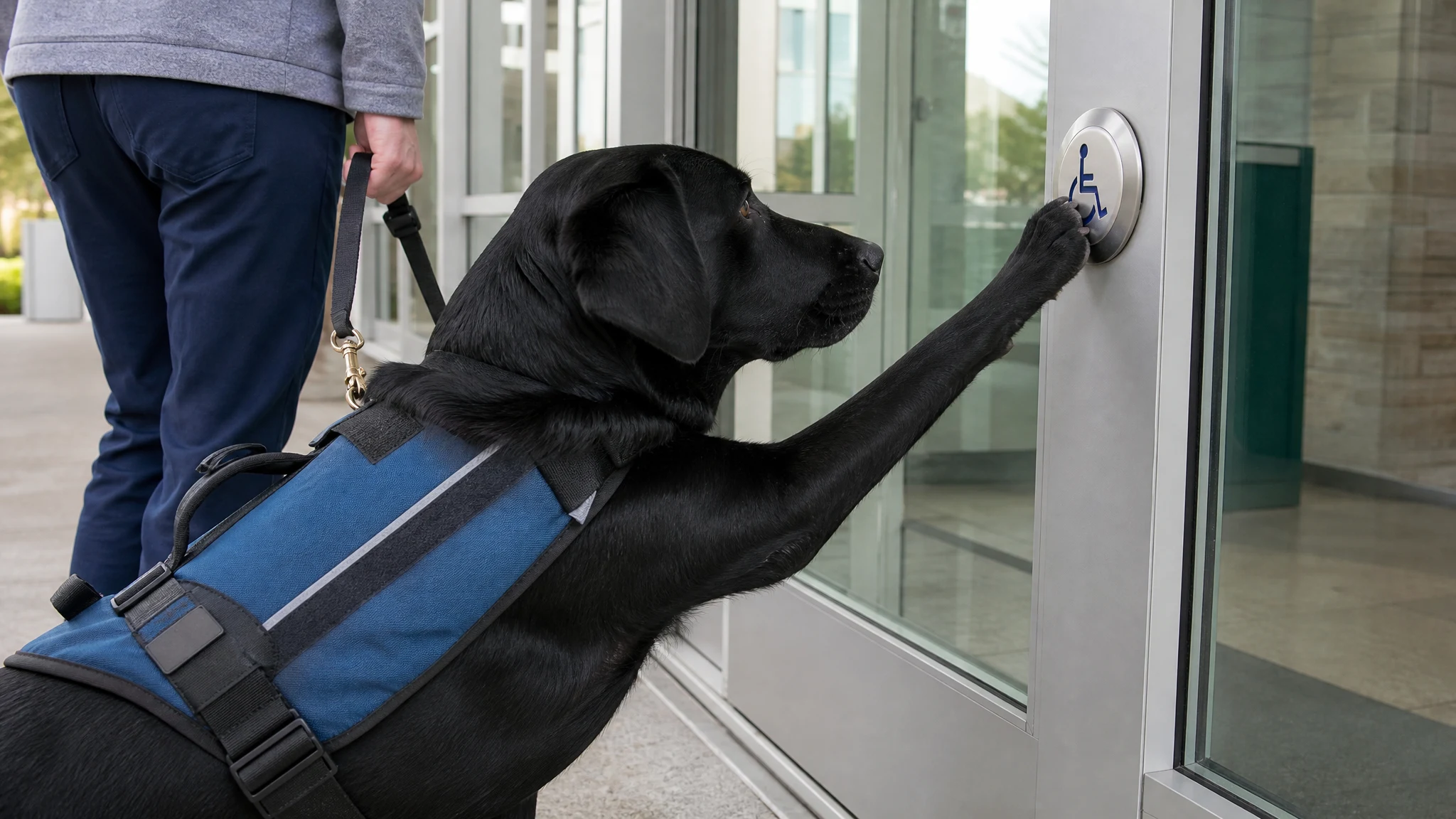
| Mobility disability | Retrieving dropped items, opening and closing doors with a strap, turning light switches on, bracing for balance when standing, pulling a manual wheelchair |
| Vision loss | Guiding around obstacles, stopping at curbs and stairs, finding a door or an empty seat |
| Hearing loss | Alerting to a doorbell, a smoke alarm or a name being called, and leading the person to the sound |
| Seizure disorder | Staying with the person during a seizure, getting help, or activating an alert device the person has set up |
| Diabetes | Alerting to scent changes linked to blood sugar changes, then fetching supplies the person keeps for treatment |
| PTSD | Interrupting nightmares, creating space in a crowd by standing behind or beside the person, turning on lights in a room before the person enters |
| Psychiatric disability | Interrupting repetitive or self-injuring behavior, prompting medication at set times |
| Heart or blood pressure conditions | Alerting to changes the dog has been trained to notice, then fetching a phone or medication |
Georgia programs that place dogs describe the same kinds of work. Canine Assistants in Milton, for example, says it serves people with physical disabilities, seizure disorders and Type 1 diabetes. Warrior Freedom Service Dogs and K9s For Warriors say they serve veterans with PTSD and traumatic brain injury. Check each program's own site for what it currently offers, what it costs and how long the wait is.
Step 2: Understand why comfort alone is not a task
Dogs bring comfort, and many people with disabilities feel better with a dog nearby. That is real, but the ADA draws a line. Emotional support animals, therapy animals and comfort animals are not service animals under the ADA. A dog whose only job is to be present, or to make someone feel calm by being there, is not doing a trained task.
The line can feel fine, so here is a way to see it. Compare these two cases:
- Comfort only: a dog sits next to a person with anxiety and the person feels better. The dog has not been trained to do anything specific.
- A task: a dog is trained to notice a person's trained trigger, such as a particular repetitive behavior during an anxiety episode, and to respond by nudging the person's hand or applying pressure on their lap. The dog does a defined action on a defined cue.
In the second case the action is learned, repeatable and tied to the disability. That is what the definition asks for.
Georgia changed its service dog law in 2026. According to a May 2026 summary on the Understanding the ADA blog, House Bill 668 rewrote the state definition to track the federal Title II and III regulations, and emotional support animals do not get the protections the law gives service animals. That summary is a secondary source, so read the enacted text or ask the state agency before relying on the details.
Step 3: Choose and define your tasks
- List the barriers. Write down the parts of your day where your disability makes something hard or unsafe.
- Match barriers to behaviors. For each barrier, ask whether a dog could physically and reliably do something that helps. Retrieving, opening, alerting, bracing and interrupting are common building blocks.
- Write each task as a cue and a response. For example: "When I say 'get it,' the dog picks up the dropped item and puts it in my hand." A clear description keeps your training consistent.
- Start with one or two tasks. A dog that does two tasks reliably is more useful than a dog that does six unreliably.
A dog's own trained behavior also has to be safe for the dog. Ask your veterinarian whether a task, such as bracing or pulling, suits your dog's size, joints and age.
Step 4: Teach each task in small, rewarded pieces
Break every task into steps the dog can succeed at. Here is the general approach, using retrieval as the example.
- Mark and reward interest. Reward the dog for looking at, sniffing or touching the object.
- Reward holding. Reward gentle mouth contact, then a few seconds of holding the item.
- Add movement. Reward the dog for taking a step or two while holding the item.
- Add the hand. Reward the dog for putting the item in your hand, with a calm release cue.
- Add distance and the cue. Say your cue just before the dog begins. Increase distance a little at a time.
- Vary the item and the place. Practice with keys, a phone, a bottle and a wallet, in different rooms.
Keep sessions short, usually five to ten minutes, and end while the dog is still keen. Log what worked and what did not.
Alert tasks, such as sound alerts or medical alerts, follow the same logic. The dog learns to notice a trigger and then to perform a trained response that gets a reward. Medical alert work can be hard to train reliably. If it is part of your plan, consider working with a qualified trainer or a program.
Step 5: Understand the public access test
The service dog public access test is a practical check of how a dog behaves in public places. It is usually a set of exercises in a store, a restaurant or on a sidewalk, scored by an evaluator. Assistance Dogs International (ADI) is a well-known coalition that sets standards for assistance dog programs, and its public access standard is the one many trainers have in mind. Check ADI directly for its current test items and scoring, because they can change.
It is essential to be exact about what a test is and is not:
- It is a training benchmark. It gives you a clear target and an outside view of how reliable your dog is.
- It is not an ADA requirement. ADA.gov does not require a service dog to pass a test, hold a certificate or be registered. There is no official service dog registry under the ADA.
- It is not proof of legal status. A printed card or an online registration does not make a dog a service animal, and it should not be treated as legal proof.
Because the ADA looks at individual training, staff may ask only two questions when it is not obvious what the dog does. According to ADA.gov, they are:
- Is the dog a service animal required because of a disability?
- What work or task has the dog been trained to perform?
Being able to answer the second question in one clear sentence is a good reason to define your tasks in Step 3.
Step 6: Build public access skills
Even though the ADA does not require a test, a dog that is calm and controlled in public is safer for you and easier for others to accept. Work toward these skills in stages, starting in quiet places and moving to busy ones:
- Loose-leash walking past people, strollers and other dogs.
- Settling under a table or beside a chair for long periods.
- Ignoring food that is dropped or carried past.
- Staying neutral toward strangers who talk to or reach for the dog.
- Handling noise and surprises, such as carts, doors and dropped items.
- Entering and exiting doorways and vehicles calmly, waiting for a release cue.
- Toileting on cue and staying clean and well groomed.
- Staying under control if you need to step away, for example with a trained stay.
Practice each skill with distractions at a low level first. Raise the difficulty only when the dog succeeds several times in a row. Take breaks if the dog shows stress, such as yawning, lip licking, a tucked tail or turning away.
Step 7: Practice a mock test
- Choose a public place where dogs are allowed to be with their handlers, and ask the business if you are unsure.
- Walk through the skills in Step 6 in a set order.
- Ask a friend to act as evaluator, or record yourself and review the video.
- Note any skill where the dog needed repeated cues or lost focus.
- Return to the training steps for that skill, then repeat the mock test later.
If you want an outside evaluation, ask a qualified trainer or an assistance dog program whether they offer one, and ask which standard they score against.
Tips for better sessions
- Train when the dog is alert but not frantic, and after exercise.
- Pay well for hard tasks. Use better treats in new places.
- Change one thing at a time: distance, distraction or duration.
- Write down your cues and keep them consistent among family members.
- Keep up with veterinary care and watch for pain, which can look like a behavior problem.
Common mistakes to avoid
- Calling comfort a task. If the dog is not trained to do something specific, it is not a task under the ADA.
- Buying a registration or vest and calling it done. Neither is required, and neither is legal proof. Training is what counts.
- Rushing into busy places. A dog pushed too far, too fast may become fearful or reactive.
- Using harsh corrections. Aversive tools and dominance methods go against AVSAB guidance and can damage trust.
- Treating a test as a finish line. A dog can pass one day and have a bad day later. Keep proofing skills.
- Training too many tasks at once. Reliability matters more than a long list.
What results to expect
With steady, reward-based practice, many handlers see their dogs become more focused and more dependable over several months. Some dogs may take much longer, and some may turn out not to suit service work. That is not a failure on your part. Temperament, health, age and the complexity of the tasks all affect the timeline, and no outcome is certain. Program wait times and costs vary too, so confirm them with the program itself.
Where Georgia law fits in
Georgia has its own statutes on access for people with service dogs. Before 2026, the code (O.C.G.A. 30-4-2) tied access for trainers and puppy raisers to affiliation with a school. A May 2026 summary says House Bill 668 changed several parts of this, including who may train a service dog and rules for dogs in training. The same summary and FOX 5 Atlanta report that it is now illegal to falsely claim an animal is a service dog. These details come from news and legal-blog coverage, so confirm the current wording of the law before relying on it.
For more on access rights, training and where the law applies, see our guide to service dogs in Georgia: training, access rights and where they apply.
If you believe you were denied access, the ADA.gov service animal FAQ is the place to start for federal rights and complaint information. For Georgia law, check with the relevant state agency.
Sources
- ADA.gov, Frequently Asked Questions about Service Animals
- Understanding the ADA blog, summary of Georgia HB 668
- FOX 5 Atlanta, new Georgia laws taking effect July 1, 2026
- Georgia Code 30-4-2 (text before the 2026 changes)
- North Georgia Living, profile of Canine Assistants
- Warrior Freedom Service Dogs
- K9s For Warriors